


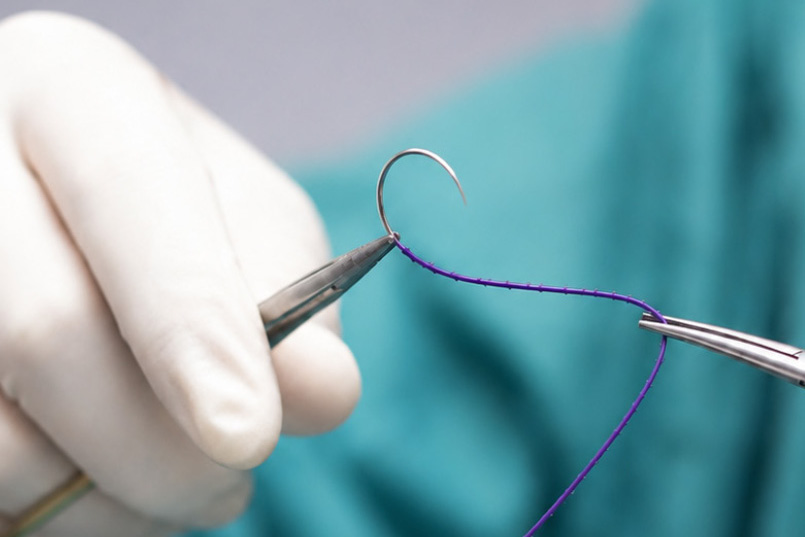
The cost of an operating theatre hour has been estimated at £1,200, or £20 per minute1. With the NHS under continual pressure to improve productivity and manage costs, efficiencies that reduce time in theatre, without compromising patient safety or quality of care, are becoming increasingly important.
Wound closure is a critical and often time-intensive stage of surgery, which can account for a meaningful proportion of operating-theatre time. As a result, advances in wound-closure techniques and technologies are attracting increased interest from clinicians seeking to improve procedural efficiency.
One important area of development is surgical sutures. Although their fundamental purpose remains unchanged, suture materials and designs have evolved significantly to meet modern clinical and operational demands. But could clinicians be overlooking an opportunity to improve efficiency through their choice of suture and, in turn, help reduce theatre time and associated costs? This article explores one such innovation and the potential difference it could make to modern wound closure.
The Evolution of Surgical Sutures
The principle of using a thread or ligature to bring tissue together is one of surgery’s oldest practices. Early surgeons used natural materials such as linen, silk, animal tendon and catgut to close wounds and support healing2. Over time, advances in sterilisation, manufacturing and material science made sutures more reliable, consistent and suitable for a wider range of clinical applications2.
Modern sutures are now designed around more than simply holding tissue in place. Surgeons can select materials and configurations based on factors such as handling, tensile-strength retention, absorption profile and the requirements of the procedure3. As surgical techniques and operating-theatre demands have evolved, so too has the need for wound-closure solutions that support both secure approximation and procedural efficiency.
The Limitations of Conventional Sutures
Conventional sutures are typically placed using either an interrupted or continuous technique. Interrupted sutures use a series of individual stitches, each secured with a knot. This approach allows precise adjustment at individual points along the wound, but requires repeated knot tying and uses more material. Continuous sutures use a single strand to close a longer section of tissue, which can be quicker to place but still relies on knots at the beginning and end of the suture line2.
In both approaches, knots are central to maintaining tissue approximation. However, knot tying adds time to the closure process and introduces additional suture material into the wound. Achieving consistent tension also depends on the technique used and the operator’s handling of the suture. These considerations have driven interest in closure technologies designed to secure tissue along the length of the wound while reducing reliance on traditional knots3.
The Solution to Improving Efficiency
Manufacturers have continued to explore ways of improving the efficiency and performance of wound closure, with innovations including surgical staples, tissue adhesives, and advanced suture materials offering alternatives to conventional knot-based techniques. One important technological development and potential solution is the creation of the barbed suture.
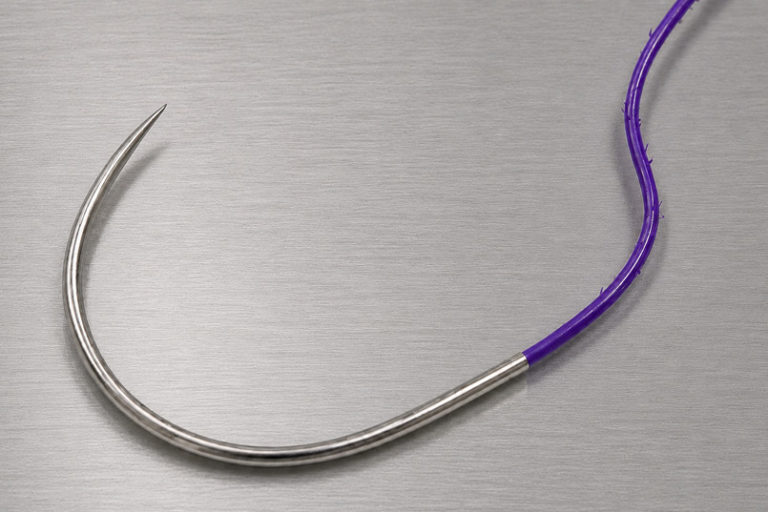
Figure 1: A Barbed Suture
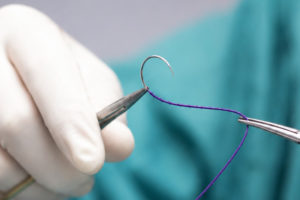
Barbed sutures, like the one shown in Figure 1, were developed as an evolution of conventional closure, addressing the reliance on knots to secure a suture line. Rather than depending on knots at specific points, a barbed suture features small, precisely angled projections along the strand. These barbs engage with surrounding tissue as the suture is advanced, helping to anchor it in place4.
This design supports knotless tissue approximation: the suture can maintain its position along the wound without the need for traditional knot tying. By engaging tissue at multiple points along the suture line, barbed technology is designed to provide more evenly distributed tension and support a continuous closure technique8. The aim is not to change the fundamental objective of wound closure, but to provide an alternative method of achieving it that may be more streamlined in appropriate procedures.
While modern barbed sutures became commercially available in the mid-2000s, their use became more established across selected specialities during the 2010s, particularly in minimally invasive, gynaecological, orthopaedic and plastic surgery 4,5,6. More recently, evidence has suggested there is an increasing use of barbed sutures in the last five years, reflecting their growing role in the operating theatre7.
The Evidence
A range of studies across different surgical specialties and procedures has compared barbed sutures with conventional sutures, creating an expanding evidence base for their use. Selected examples are shown in Figure 2.
| Procedure | Conventional Closure Time | Barbed Closing Time | Efficiency Saving |
|---|---|---|---|
| Total Knee Arthroplasty9 | 16 Minutes 6 Seconds | 11 Minutes 24 Seconds | 29% Quicker |
| Total Hip Arthroplasty - Arthrotomy closure10 | 8 Minutes | 3 Minutes | 63% Quicker |
| Total Joint Arthroplasty – Hip11 | 18 minutes 15 Seconds | 12 Minutes | 34% Quicker |
| Total Joint Arthroplasty - Knee11 | 18 minutes 43 Seconds | 13 Minutes 11 Seconds | 30% Quicker |
| Dermal Closure, Multicentre12 | 19 Minutes 12 Seconds | 12 Minutes | 38% Quicker |
| Lipoabdominoplasty13 | 12 Minutes 18 Seconds | 7 Minutes 54 Seconds | 36% Quicker |
| Caesarean delivery - hysterotomy closure14 | 5 Minutes 24 Seconds | 4 Minutes 6 Seconds | 24% Quicker |
| Average Time Across the Studies | 14 Minutes | 9 Minutes 5 Seconds | 36% Quicker |
Figure 2: Efficiency Savings of Using Barbed Sutures Compared to Conventional Sutures.
The studies in Figure 2 show reduced closure times with barbed sutures across a range of procedures. On an unweighted basis, the studies shown report an average reduction in closure time of 36% compared with conventional sutures. Although outcomes will vary according to procedure, technique and suture selection, these findings highlight the potential for more efficient wound closure to help release valuable operating-theatre time and support cost-management efforts.
Patient Outcomes
Although the studies show an efficiency saving with barbed over conventional sutures, this doesn’t mean anything without ensuring the patient outcomes are at least the same, if not better. Various studies have shown barbed sutures show encouraging results for patient outcomes. During Caesarean procedures, barbed sutures were associated with less blood loss and fewer additional haemostatic sutures required 15. This reported reduced blood loss was also found during laparoscopic myomectomies16 and laparoscopic partial nephrectomies 17. In the lipoabdominoplasty study, fewer postoperative wound complications were observed13.
– Reduced Blood Loss
– Fewer Postoperative Wound Complications
With the studies showing reduced blood loss and fewer postoperative wound complications, the evidence suggests that barbed sutures not only improve surgical efficiency, but also have a positive patient outcome over conventional sutures.
Introducing Barb-E® Barbed Sutures
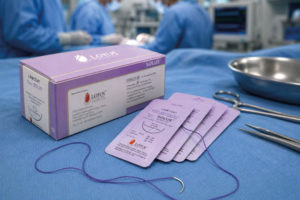
Barb‑E® Barbed Sutures offer a practical example of how modern barbed-suture technology can be applied to support efficient internal tissue closure. Manufactured by TI Medical and distributed by Uniplex, Barb‑E® is a monofilament, absorbable polydioxanone (PDO) barbed suture designed to provide knotless tissue approximation.
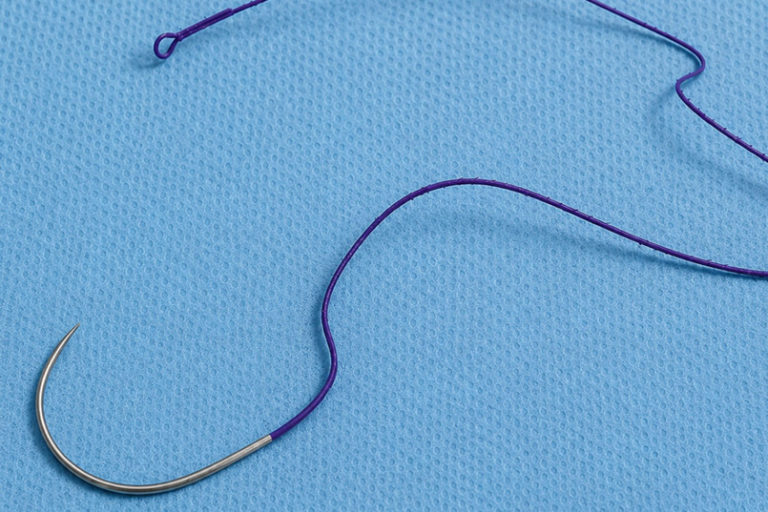
Figure 3: Barb-E® Barbed Sutures by TI Medical
Its dual-angle barb design is intended to provide secure anchoring while helping to preserve the integrity of the suture strand. The range includes a uni-directional configuration with an end loop and a bi-directional configuration with needles at both ends, enabling clinicians to select an option that suits their technique and procedural requirements.
By removing the need for traditional knots and supporting consistent tension along the suture line, Barb‑E® is designed to help streamline wound closure while providing the long-lasting absorbable support required for internal tissue approximation.
To Summarise
- More and more clinicians are using barbed sutures to achieve superior surgical efficiency
- Over a range of studies, using barbed sutures over conventional sutures led to an average of 36% quicker suturing
- Barbed sutures provide better patient outcomes through reduced blood loss and fewer postoperative wound complications
- TI Medical manufacture the Barb-E® barbed suture that is distributed in the UK by Uniplex
Get in Touch
You can see the Barb-E® product by Clicking Here. If you would like to know which code to order, you can configure the suture specification by Clicking Here.
If you would like more information on Barbed Sutures, please get in touch:
info@uniplexuk.com
0114 241 3410
References
1) NHS Supply Chain (2022) Value Based Procurement Pilot Releases Theatre Time and Inpatient Bed Capacity. Available at: https://www.supplychain.nhs.uk/news-article/value-based-procurement-pilot-releases-theatre-time-and-inpatient-bed-capacity/ (Accessed: 24 August 2026).
2) Muffly, T.M., Tizzano, A.P. and Walters, M.D. (2011) ‘The history and evolution of sutures in pelvic surgery’, Journal of the Royal Society of Medicine, 104(3), pp. 107–112. doi: 10.1258/jrsm.2010.100243.
3) Abhari, R.E., Martins, J.A., Morris, H.L., Mouthuy, P.-A. and Carr, A. (2017) ‘Synthetic sutures: Clinical evaluation and future developments’, Journal of Biomaterials Applications, 32(3), pp. 410–421. doi: 10.1177/0885328217720641.
4) Greenberg, J.A. (2013) ‘Barbed suture: A review of the technology and clinical uses’, American Journal of Obstetrics and Gynecology, 208(4), pp. 307–311. Available at: https://pmc.ncbi.nlm.nih.gov/articles/PMC4002186/ (Accessed: 24 August 2026).
5) Gowri, K.N., Hiranandani, R., M, S. and Muralidharan, N. (2023) ‘A review of barbed sutures—evolution, applications and clinical significance’, Bioengineering, 10(4), 419. doi: 3390/bioengineering10040419.
6) Rosen, A.D., et al. (2013) ‘New and emerging uses of barbed suture technology in plastic surgery’, Aesthetic Surgery Journal, 33(1 Suppl), pp. 90S–95S. Available at: https://pubmed.ncbi.nlm.nih.gov/24084885/ (Accessed: 24 August 2026).
7) Johnson, B.H., T., S., Johnston, S.S. and Gunja, N. (2025) ‘Trends in adoption of knotless tissue control devices in robotic surgery’, Journal of Comparative Effectiveness Research, 14(16), e240229. doi: 10.57264/cer-2024-0229.
8) Paul, M.D. (2009) ‘Bidirectional barbed sutures for wound closure: A review of the technology and applications’, Aesthetic Surgery Journal, 29(2), pp. 134–139. Available at: https://pmc.ncbi.nlm.nih.gov/articles/PMC3478908/ (Accessed: 24 August 2026).
9) Sah, A.P. (2015) ‘Is there an advantage to knotless barbed suture in TKA wound closure? A randomized trial in simultaneous bilateral TKAs’, Clinical Orthopaedics and Related Research, 473(6), pp. 2019–2027. Available at: https://pubmed.ncbi.nlm.nih.gov/25631171/ (Accessed: 25 August 2026).
10) Sundaram, K. et al. (2021) ‘Barbed sutures reduce arthrotomy closure duration and suture utilisation compared to interrupted conventional sutures for primary total hip arthroplasty: A randomised controlled trial’, Hip International, 31(5), pp. 582–588. doi: 10.1177/1120700020911891.
11) Li, R., Ni, M., Zhao, J., Li, X., Zhang, Z., Ren, P., Xu, C. and Chen, J.-Y. (2018) ‘A modified strategy using barbed sutures for wound closure in total joint arthroplasty: A prospective, randomized, double-blind, self-controlled clinical trial’, Medical Science Monitor, 24, pp. 8401–8407. doi: 10.12659/MSM.912854.
12) Rubin, J.P., Hunstad, J.P., Polynice, A., Gusenoff, J.A., Schoeller, T., Dunn, R. and Walgenbach, K.J. (2014) ‘A multicenter randomized controlled trial comparing absorbable barbed sutures versus conventional absorbable sutures for dermal closure in open surgical procedures’, Aesthetic Surgery Journal, 34(2), pp. 272–283. doi: 10.1177/1090820X13519264.
13) Grigoryants, V. and Baroni, A. (2013) ‘Effectiveness of wound closure with V-Loc 90 sutures in lipoabdominoplasty patients’, Aesthetic Surgery Journal, 33(1), pp. 97–101. doi: 10.1177/1090820X12467797.
14) Tavella, N.F., Buckley, A.B., Cabrera, C., Lambert, C.E., Mills, A., Paul, K.S., Patel, M.J., Vieira, L.A., Bianco, A.T. and Stone, J.L. (2026) ‘Stratafix vs Vicryl suture for hysterotomy closure in scheduled cesarean deliveries: A randomized clinical trial’, American Journal of Obstetrics and Gynecology, 233(6), pp. S331–S342. doi: 10.1016/j.ajog.2025.04.053.
15) Peleg, D., Ahmad, R.S., Warsof, S.L., Marcus-Braun, N., Sciaky-Tamir, Y. and Ben Shachar, I. (2018) ‘A randomized clinical trial of knotless barbed suture vs conventional suture for closure of the uterine incision at cesarean delivery’, American Journal of Obstetrics and Gynecology, 218(3), pp. 343.e1–343.e7. doi: 10.1016/j.ajog.2018.01.043.
16) Kathopoulis, N., Prodromidou, A., Douligeris, A., Diakosavvas, M., Zacharakis, D., Kypriotis, K., Chatzipapas, I., Grigoriadis, T. and Protopapas, A. (2024) ‘Barbed sutures compared with conventional sutures during laparoscopic myomectomy: A systematic review and meta-analysis’, Obstetrics & Gynecology, 144(4), pp. e81–e100. doi: 10.1097/AOG.0000000000005695.
17) Zhan, H., Huang, C., Li, T., Yang, F., Cai, J., Li, W., Mao, Y. and Zhou, X. (2019) ‘The self-retaining barbed suture for parenchymal repair in laparoscopic partial nephrectomy: A systematic review and meta-analysis’, Surgical Innovation, 26(6), pp. 744–752. doi: 10.1177/1553350619856167.